Safe Food Starts Long Before It Reaches Our Plates

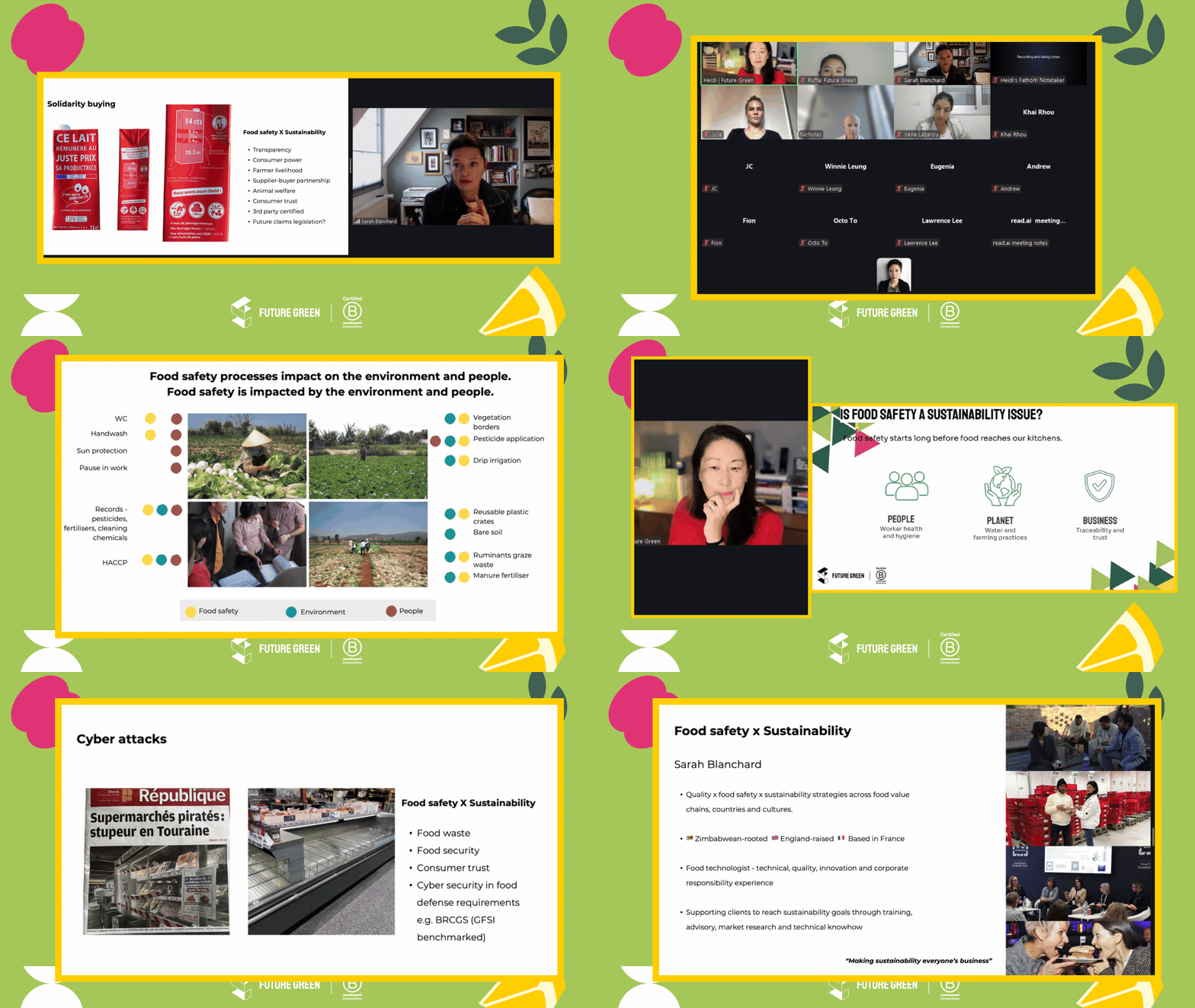
What do cyberattacks on supermarket freezers, fair payments to dairy farmers and pesticide use on a vegetable farm have in common?
At first glance, not much.
But each tells us something important about the relationship between food safety and sustainability.
At our November Future Green Members Monthly Meetup, we explored this connection with Sarah Blanchard, Sustainability and Food Safety Expert, who shared practical examples from her international experience working across food supply chains. The session brought together participants from Hong Kong, Singapore, Cyprus and beyond to discuss a question that deserves more attention:
Food Safety Is More Than a Kitchen Responsibility
When we talk about sustainable food, conversations often focus on carbon emissions, food waste, packaging and responsible sourcing.
But what about the safety of the food itself?
Food safety begins long before ingredients reach our kitchens. It starts with healthy soils, clean water, responsible farming practices, worker wellbeing and the systems that protect food throughout the supply chain.
Heidi opened the session by introducing the One Health approach, which recognises the interconnected relationship between human health, animal health and environmental health.
This connection is particularly important as food businesses face increasing challenges from climate change, complex supply chains, antimicrobial resistance and unequal access to safe infrastructure.
The science behind food safety has advanced significantly, yet foodborne illness remains a major global challenge.
As Heidi reminded participants, the issue isn’t simply a lack of scientific knowledge. It’s how we apply that knowledge across the entire food system.

The One Health model illustrating the interconnectedness of human, animal, and environmental health (USGS, 2023).
When a Cyberattack Becomes a Food Safety Problem
One of Sarah’s most surprising examples came from France, where cyberattacks reportedly disrupted refrigeration systems across hundreds of supermarkets.
Hackers interfered with temperature controls, compromising chilled and frozen products.
Sarah described visiting a supermarket where entire refrigerated sections had been emptied. Meat, dairy and other perishable products had to be discarded.
The consequences went beyond food waste.
Businesses faced financial losses, potential increases in insurance costs and concerns about consumer confidence.
But Sarah raised an even more troubling question:
Food could appear perfectly safe while having been exposed to unsafe temperatures.
The example highlighted why cybersecurity, equipment monitoring and food safety can no longer be treated as separate operational concerns.
For food businesses, protecting digital infrastructure is also part of protecting the food supply.
And when food is discarded because safety cannot be guaranteed, the environmental and economic costs become impossible to ignore.

An empty refrigerated aisle in a French supermarket after cyberattacks compromised temperature controls and forced the disposal of perishable goods (SCMP, 2026).
Can Consumers Help Farmers Earn a Fairer Price?
Another example came from a French initiative called C’est qui le Patron?!, which translates to Who’s the Boss?!
The consumer-led brand takes a different approach to food production and pricing.
Rather than leaving pricing decisions entirely to retailers and manufacturers, consumers participate in determining a price that allows farmers to earn a fairer living while meeting production standards.
Sarah explained how the initiative makes its pricing structure transparent, showing how much goes to farmers, processing, distribution and other costs.
Independent verification and consumer involvement help support accountability.
The initiative also considers animal welfare and environmental practices, demonstrating how responsible sourcing can bring several sustainability priorities together.
But Sarah also highlighted an important challenge.
The initiative previously introduced a chocolate product but discontinued it because it could not guarantee the agreed price under commercially viable conditions.
This raised an uncomfortable question during the discussion:
Fair pricing sounds straightforward, but making it work requires cooperation between farmers, retailers, manufacturers and consumers.
It also challenges businesses to think beyond the lowest purchasing price and consider whether their suppliers can afford to maintain safe and responsible production practices.

Milk cartons from the consumer-led brand C’est qui le Patron?!, highlighting transparent pricing structures designed to secure fairer compensation for dairy farmers.
What a Cabbage Farm in Vietnam Can Teach Us
Perhaps the most practical part of the meetup was Sarah’s case study from a vegetable farm in Vietnam.
During her time working across Asian food supply chains, Sarah visited a farm supplying fresh cabbages to a major retailer.
At first glance, the farm appeared to be a straightforward agricultural operation.
But looking more closely revealed how food safety, environmental protection and worker wellbeing intersect at almost every stage.
1. Access to Toilets Is a Food Safety Issue
Sarah pointed out that the farm had accessible toilets and handwashing facilities for workers.
This might seem like a basic requirement, but it has significant implications.
Proper sanitation helps prevent contamination of fresh produce. It also protects workers’ health, dignity and personal safety.
For female agricultural workers in particular, safe and accessible facilities are an important part of workplace wellbeing.
One simple facility can therefore address both food safety and social sustainability concerns.
2. Pesticide Management Affects More Than Crops
Another photograph showed a worker applying pesticides without adequate protective equipment.
Sarah explained how this created several potential risks.
The worker could be exposed to harmful chemicals, nearby employees could be affected by pesticide drift, and surrounding ecosystems could experience negative impacts.
Depending on application practices and harvesting intervals, pesticide residues could also create food safety concerns.
The example demonstrated why responsible pesticide management needs to consider workers, consumers and the environment together.
3. Turning Farm Waste into Fertiliser Requires Care
Sarah also described how the farmer allowed cattle to eat leftover cabbages after harvesting.
The cattle produced manure, which was collected and composted for use as fertiliser during future growing seasons.
From a circular economy perspective, this was an excellent example of putting agricultural waste to productive use.
However, manure that hasn’t been properly treated can introduce harmful microorganisms, including E. coli, into the growing environment.
Sarah recalled initially being concerned about the large manure pile.
Fortunately, the agronomist accompanying her understood the composting process and was able to assess its condition.
The experience reinforced an important lesson:
Rather than immediately replacing natural fertiliser with purchased alternatives, businesses need to understand the risks and work with farmers to manage them effectively.

Sarah Blanchard and an agronomist reviewing farm logbooks and safety records with local staff, highlighting worker wellbeing and food safety.
The Questions Every Food Business Should Ask Its Suppliers
Towards the end of the session, Sarah encouraged participants to return to some surprisingly simple questions.
- Who actually supplies our food?
- Where was it grown, raised or produced?
- How was it produced?
- Who are the people involved in producing it?
- What support do our suppliers need to improve their practices?
These questions sound basic, yet many food businesses cannot answer all of them across their entire supply chain.
Sarah encouraged businesses to start with their most important or highest-risk products and work backwards towards the original source.
Understanding suppliers isn’t only about checking compliance.
It also means building relationships, listening to their challenges and identifying opportunities to improve together.
Sometimes that might involve better technical guidance. In other cases, it could mean longer contracts, fairer purchasing arrangements or stronger collaboration between procurement and sustainability teams.
Responsible sourcing works best when suppliers are treated as partners, not simply businesses to audit.
Breaking Down the Silos Between Food Safety and Sustainability
One theme kept returning throughout the conversation: the importance of collaboration.
Food safety professionals often work separately from procurement, sustainability, operations and commercial teams.
Yet decisions made by one department can have significant consequences for another.
A packaging change intended to reduce environmental impact might introduce new food contact safety considerations.
A decision to reduce food waste could create risks if temperature controls or hygiene practices are overlooked.
And a purchasing decision based primarily on cost might leave farmers without sufficient resources to invest in safer production methods.
Sarah emphasised that food safety professionals have valuable knowledge to contribute to broader sustainability strategies.
The challenge is creating opportunities for different teams to work together and understand the trade-offs involved.
For businesses, this means moving beyond individual sustainability targets and considering how decisions affect the entire food system.
What’s Next for Food Safety and Sustainability?
Before closing, Sarah also introduced her Fooders Digest, which explores developments in food, drink and packaging through both food safety and sustainability perspectives.
She shared news of a forthcoming collaborative book featuring 100 stories from around the world about food safety, sustainability and culture, with publication planned for 2028.
These initiatives reflect a growing interest in understanding how food safety decisions are made and what happens when environmental, social and commercial priorities intersect.
Our November meetup left us with an important reminder:
Whether we’re discussing farming, sourcing, technology, or worker wellbeing, the decisions we make throughout the supply chain have consequences for people, businesses and the planet.
And progress begins by asking better questions, sharing knowledge and working together.
See Sarah Blanchard’s supplier questions for food businesses here.
🌱 Continue the Conversation: Join the Future Green Membership
Our monthly meetups are just one way we bring food sustainability professionals together to learn from real-world experiences, exchange ideas and turn knowledge into action.
As a Future Green Member, you’ll become part of a community exploring the challenges and opportunities shaping our food system.
From responsible sourcing and food safety to carbon emissions, biodiversity and food waste, we tackle important topics through practical discussions and shared learning.
🌿 Join Our December Meetup: Healthy Soils
What does healthy soil have to do with the food we eat and the future of our food system?
For our final monthly meetup of 2026, we’ll turn our attention to Healthy Soils, exploring why soil health matters for sustainable food production, biodiversity and long-term food system resilience.
Join us in December as we continue connecting the dots across our food system.
📅 December 2026 | Date and registration details to follow
👉 Join our Future Green Membership to stay connected and receive upcoming meetup updates.
We look forward to seeing you at our next conversation!
Keep up to plate
Fortnightly stories from Asia's go-to food sustainability consultancy
