BEYOND THE LABEL: WHAT’S REALLY BEHIND YOUR SEAFOOD?
Hong Kong has a deep relationship with seafood. From wet markets and neighborhood restaurants to hotels and catering, seafood is an important part of how we eat. But responsible sourcing is rarely as simple as choosing a product with a sustainability label.
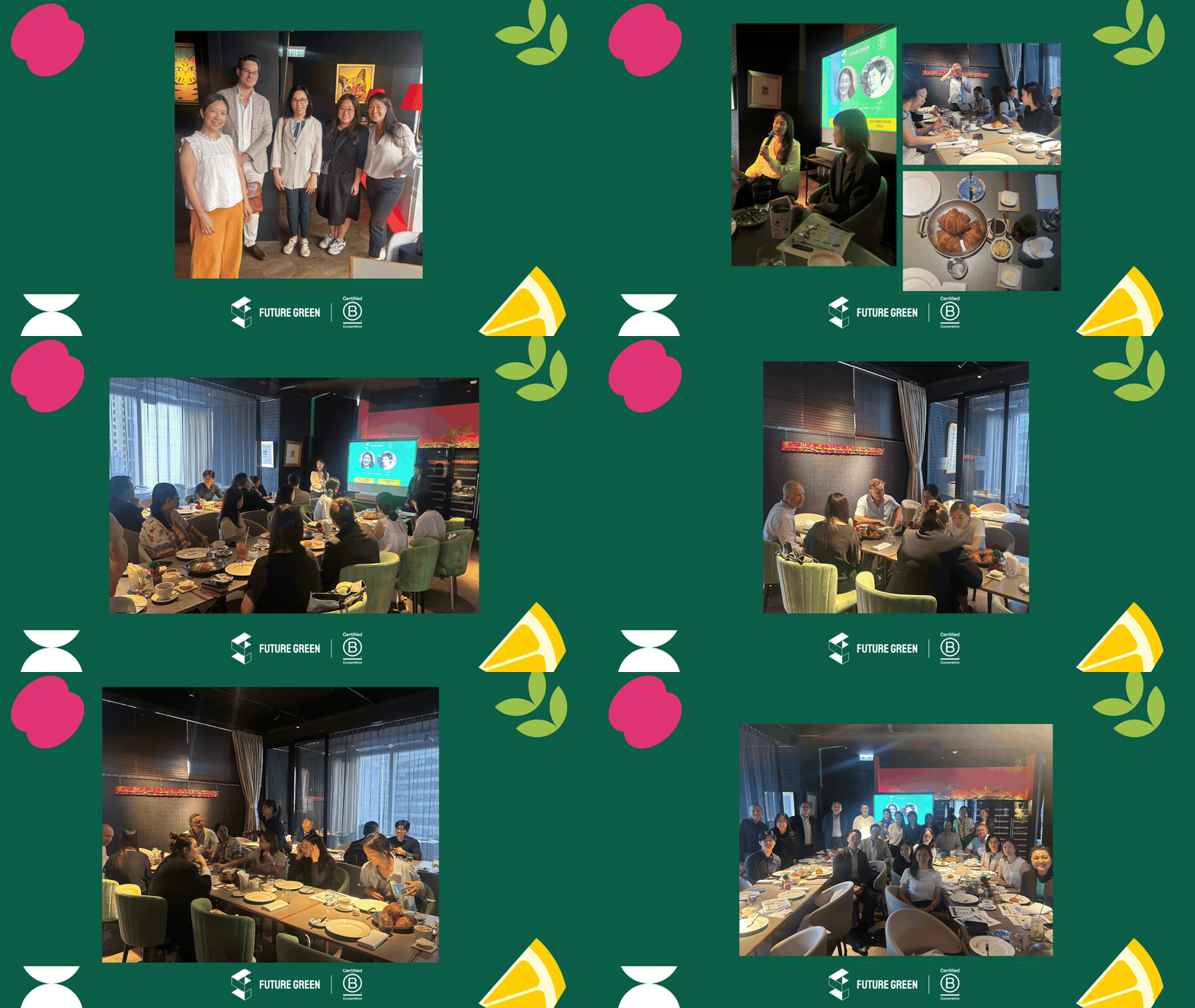
At our latest Future Green In-Person Members Meetup, Source Seafood Responsibly, we gathered over breakfast with Chef Sandy Keung of TABLE to explore what responsible seafood sourcing looks like in practice. The conversation covered local and seasonal species, shellfish depuration, animal welfare, traceability, illegal fishing and what changing oceans could mean for future menus.
This meetup was sponsored by Invest Hong Kong (InvestHK), whose support helps us bring the Future Green community together to learn, exchange ideas and turn sustainability conversations into action.
Looking beyond sustainability labels
One of the strongest messages from the morning was that responsible seafood sourcing starts with asking better questions.
Certifications such as the Marine Stewardship Council (MSC) for wild-caught seafood andAquaculture Stewardship Council (ASC) for farmed seafood can provide a useful starting point. But a label is only one piece of a much bigger picture.
Where was the seafood caught or farmed? How was it caught? How far has it travelled? How was it handled? And what do we know about the people working within its supply chain?
This becomes particularly important when considering Illegal, Unreported and Unregulated (IUU) fishing. Discussion during the meetup highlighted how irresponsible fishing practices can affect marine ecosystems through destructive fishing methods and bycatch, while opaque supply chains can also carry serious worker safety and human rights risks.
Chef Sandy’s approach: Eat with the seasons
For Sandy, sustainability does not begin with ESG terminology.
After an 18-year career in finance, she moved into hospitality and has now spent more than a decade building her restaurant business. Her approach to seafood is strongly influenced by Traditional Chinese Medicine and seasonal Chinese eating.
Rather than designing a menu around imported staples such as salmon and cod, Sandy regularly visits Hong Kong’s wet markets, including Aberdeen and Ap Lei Chau, to see what local fishermen are actually bringing in.
That can mean choosing smaller, bonier and less familiar fish, including species fishermen traditionally keep for themselves because of their flavour.
Her philosophy is refreshingly practical:
Instead of asking diners to choose something because it is “sustainable”, seasonal and locally sourced ingredients can simply become part of soups, set menus and dishes because they taste good and make sense at that time of year.

Before seafood reaches the plate
Responsible sourcing does not finish when seafood arrives at the restaurant.
Sandy gave members a fascinating look at depuration, the controlled process she uses to allow live shellfish to purge waste before it is served.
Her tanks are carefully managed according to the needs of each species, including temperature, salinity and pH, with ozone used as part of the water treatment process. Different seafood requires different amounts of time. Sandy described oysters spending around 24 hours in the system, while heavily soiled stock may require considerably longer.
The distinction between simply keeping seafood alive and actively managing its condition was an important part of the conversation.
For Sandy, handling, transportation, stress, animal welfare, quality and waste are interconnected. Her approach is simple:
Local sourcing can challenge our assumptions
Sandy also challenged some familiar assumptions about what makes a dish sustainable.
She shared an example involving locally sourced Lamma Island abalone and seaweed, where the carbon footprint compared favourably with an alternative using imported, conventionally farmed plant ingredients.
The takeaway was not that seafood is inherently lower carbon than vegetarian food. Instead, it highlighted why sustainability decisions need to consider how and where ingredients are produced, rather than relying on a single characteristic such as “local”, “plant-based” or “seafood”.
Seasonality can also become an opportunity for chefs. With hairy crab season approaching, Sandy talked about preparing for the ingredient, including using a separate freshwater tank and depurating the crabs on arrival, while making the experience easier for diners by doing the shelling for them.
 Some of our guests at the September Meetup.
🐙 The octopus question
One of the most thought-provoking conversations of the morning centred on octopus.
Recent octopus blooms in warmer waters around parts of the UK and Europe offer an interesting sustainability dilemma. If a species suddenly becomes more abundant, should we simply eat more of it?
The answer becomes complicated quickly.
Greater abundance could create opportunities for fishing communities and encourage menus to respond to what is available. But octopus are predators of species including crabs and lobsters, meaning changing populations can have knock-on effects across marine ecosystems.
The conversation also moved into animal welfare. A member referenced the documentary My Octopus Teacher and how it has contributed to greater public awareness of octopus sentience.
It left us with an important question:
When changing ocean conditions make one species more abundant, does that automatically make it a sustainable choice?
There may not be a simple answer. That is exactly why understanding the wider food system matters.
Bringing the conversation into businesses and classrooms
The Q&A showed how seafood can open conversations far beyond restaurant procurement.
Monica from Chinese International School (CIS) reflected on the social dimension of an oyster and imagined using its journey as a creative writing exercise for students, even picturing the story of a “happy oyster” in a tank. It was a great example of how sustainability can become part of everyday teaching material.
Alistair from Iseal Alliance shared his knowledge around seafood labelling and IUU fishing, while Tom from Compass Group connected with Sandy’s approach to introducing local ingredients into dishes and shared how their teams are exploring more accessible sustainability solutions.
These conversations reinforced something we see repeatedly at Future Green: sustainability becomes much more tangible when people can connect it to their own kitchens, classrooms, businesses and supply chains.
 We finished the meetup with a practical resource: Future Green’s Top 10 Questions to Ask Your Seafood Supplier.
Thank you to our community
A huge thank you to Chef Sandy Keung and the TABLE team for welcoming our community and sharing such an open and practical perspective on seafood sourcing.
💚 What’s Next?
👉 Join the Future Green Membership for practical tools, expert insights, and a growing community driving positive change across food and hospitality
📅 Book a discovery call to explore how Future Green can support your sustainability journey
How sustainable is your menu?
Are you curious about your food’s impact?

“We have just become a member of this community and the meet-ups are very well organised and we were able to drive awareness for our initiatives. Keep it up, Futuregreen!”
“Thanks for inviting me to the Future Green Meetup! I was impressed with the high level of engagement. Good Job on creating such a community!”

Interested in more?
2026
I Thought I Was Hosting a Facilitation Retreat. It Became Something Much More…
 25th September
2026
Bringing Food Sustainability into the Classroom: Future Green’s Lunch & Learn at Chinese International School
27th August2026
Seven Years of Future Green: What I’ve Learnt About Creating Change