How to Run a Retreat for Facilitators and Consultants – THE FACILITATION PRACTICE LAB SERIES 5 OF 5.
Part of a learning series:
This five-part series explores how entrepreneurs can turn their expertise into a high-value strategic workshop skill, drawing on the lessons from Future Green’s Facilitation Practice Lab in Sintra, Portugal.
In the last blog, I reflected on hosting the five-day retreat for independent consultants, facilitators, and founders, which evolved from a facilitation practice into a powerful mastermind group.
From a note on my phone to a mastermind in the hills of Portugal. ⛰️
A year and a half ago, my retreat was a note on my phone.
Last month, a small group of independent consultants, facilitators and founders spent five days with me on a regenerative farm in the hills above Sintra, Portugal.
We practised strategic workshops, worked on our own businesses, challenged each other’s thinking, walked, ate food grown a few meters away and, by Friday, had become something none of us expected: a mastermind.
I went in thinking I was hosting a facilitation practice retreat. I came away with a much clearer idea of what it could become.
Before I booked anything, I wrote down four questions. They shaped every decision I made, from the venue to the timetable to the final conversation on Friday.
- Who is it for?
- What will they practise?
- How do I want them to feel?
- What will they do when they get home?
If you’re thinking about running a retreat of your own, start here.
 Heather hosting an honoring thinking spaces workshop.
1. Who is it for?
Be specific. A retreat for “anyone interested in facilitation” is a retreat for no one.
Mine was designed for established, independent consultants, facilitators and founders who want to design, deliver and sell strategic workshops, or create retreats of their own.
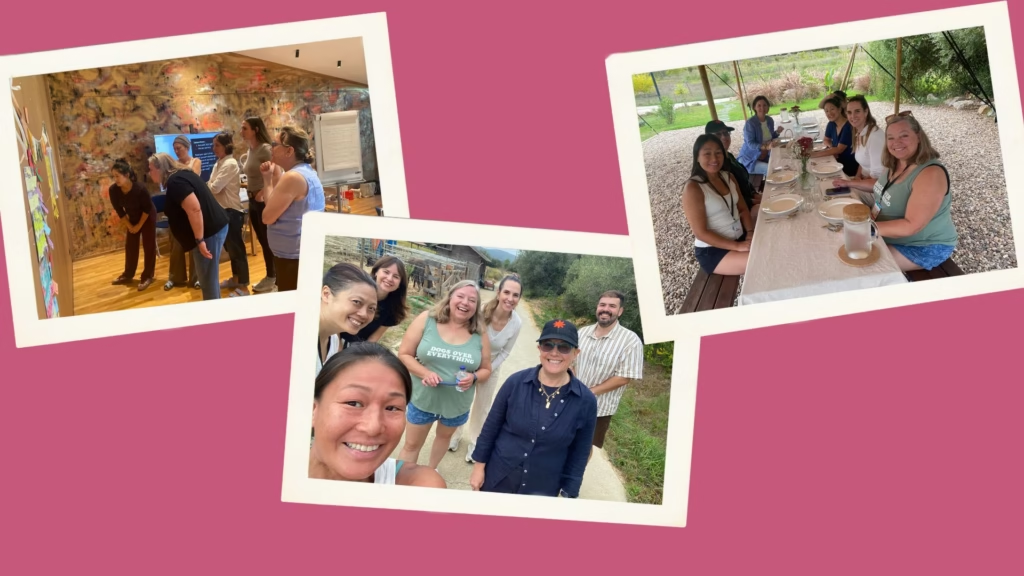
I wanted people with experience to draw on, but from different backgrounds. Our group included people from consulting, a physio practitioner, education and other sectors, at different stages of building their independent practices.
Different industries, same ambition:
That mix mattered. The people in the room weren’t just there to learn from me. They had knowledge, methods, and experiences to share.
I worried the group was too small. On day one, a participant described it as a VIP experience. By the end, another told me the group had been exactly the right size.
Every place was by application and a short call. I wanted people who would contribute as much as they hoped to take away.
The group is part of the product. Choose it deliberately.
 If your event is for “anyone,” it’s for no one
2. What will they practise?
This was the heart of the retreat.
Experienced facilitators don’t necessarily need another framework. They need opportunities to practise, get feedback, experiment, and become confident using a process with real clients.
Our backbone was the Strategy Sprint (inspired by Richard Rumelt’s Good Strategy Bad Strategy), a method I learned through AJ&Smart and have adapted through years of client work.
We worked through the stages of a strategic workshop: establishing purpose and guiding principles, exploring concepts, making decisions, planning actions, and creating a roadmap.
I didn’t want participants simply watching me facilitate. They needed to understand how the pieces fit together and experience what it feels like to guide a group through the process themselves.
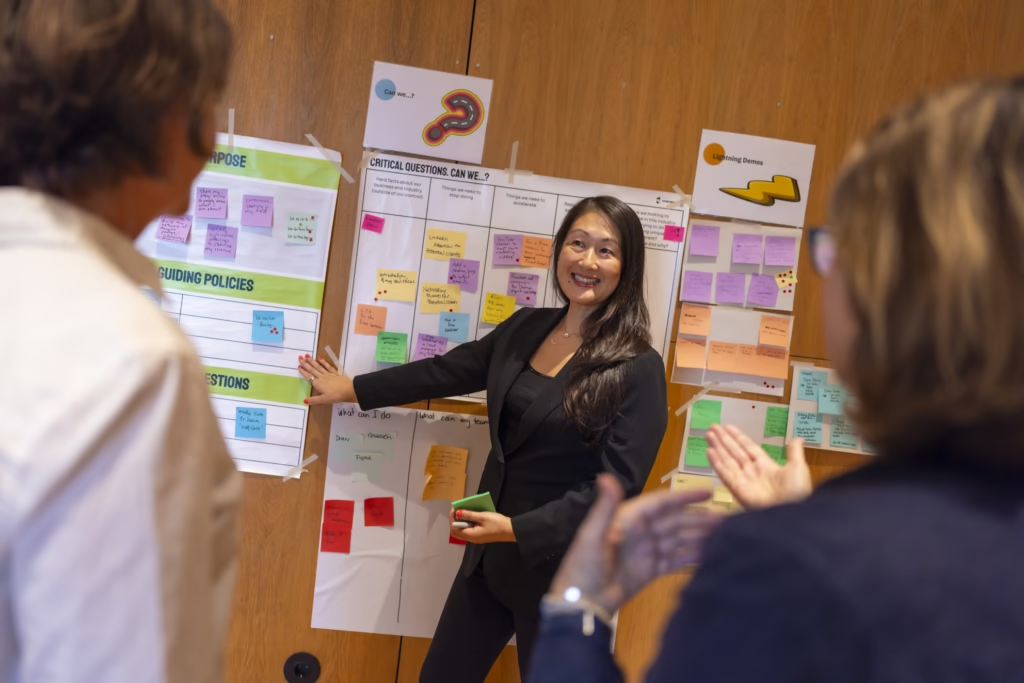
So we made the process visible. Every step was printed on posters on the wall, giving everyone a clear view of where we were, what we were doing, and what came next.
That structure gave people something they could take into their own work and adapt to their clients.
But the biggest shift came when we stopped treating the exercises as hypothetical practice.
We started using our own businesses as the case study.
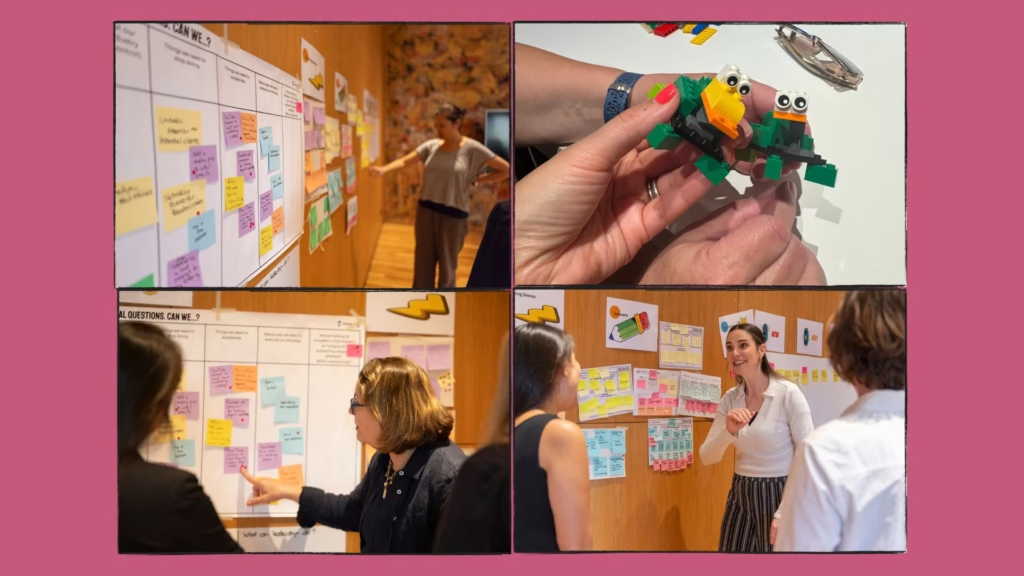
We explored positioning, marketing, client proposals, sales funnels and the decisions we had been putting off. Instead of practising on an imaginary client, participants could apply the process to challenges they actually needed to solve.
One participant gained clarity about her target market. Another left ready to start selling Strategy Sprint services. Another realised she was spending too much time trying to make things perfect instead of putting them out there and iterating.
We also experimented with combining methods – what I call MASH UPS. We brought LEGO Serious Play principles into client discovery, Liberating structures activities combined with Deloitte’s Business Chemistry, and by mashing up familiar exercises in new ways and exploring how to adapt activities to different groups. Our creative juices were flowing.
We even looked at the practicalities that make or break a workshop:
- How to design for different working styles
- How to help people understand one another
- How to keep a session moving when timings inevitably slip
Because knowing an exercise is one thing. Knowing when to use it, how to introduce it, how to adapt it, and how to help a group reach a useful outcome is another.
That is the difference between collecting tools and building facilitation capability.
3. How do I want them to feel?
Calm, curious and safe enough to experiment.
We do our best thinking when we have space to think. So the environment wasn’t an afterthought, it was part of the design.
We used the farm, the forest and the coast as places to reflect and have conversations. There was yoga, time for wellness treatments, and food made with produce grown on the farm.
We also took the learning into Lisbon for a walking workshop about visibility and brand identity.
 From a quiet farm to a walking workshop in Lisbon
As we explored the city’s history, symbols and stories, we asked ourselves:
What story are you telling the world? What do your brand and your message communicate? And how can you make your work meaningful to the people you want to reach?
Those questions led straight back to our businesses.
We talked about how different audiences need different messages: the people taking part in a workshop, the person championing it internally, and the executive approving the budget may all need to understand its value in different ways.
My favourite question was:
That changes how you think about selling your services. You’re not just offering a workshop. You’re helping someone achieve something they couldn’t reach as easily on their own.
The environment also permitted us to step away from our usual routines. When you facilitate for a living, you spend a lot of time holding space for other people. I wanted participants to have some of that space for themselves, too.
And above all, I wanted the group to feel safe enough to try things, get things wrong and learn from one another.
4. What will they do when they get home?
Inspiration is lovely. Action is better.
I wanted everyone to leave with more than a notebook full of ideas. They needed a clearer sense of what to do next, whether that meant improving their workshop design, approaching a new client or making a decision about their business.
So we moved from ideas to decisions and from decisions to action plans.
We also made time to look beyond facilitation technique and into the business of being an independent practitioner.
How do you explain what you do? Who needs your services? How do you communicate your value? What are you waiting for before you start selling?
These conversations were just as important as the workshop practice itself.
On the final day, I asked participants what they had clarified, what they would do differently, and what they were taking home.
The answers brought us back to why I had created the retreat in the first place.
One participant was ready to start selling Strategy Sprint. Another wanted to stop waiting for everything to be perfect. The message was simple: use what you know, put it out there and keep improving.
That’s how I measure a retreat. Not by how many tools I taught, but by what people feel ready to do afterwards.
What I learned about running a retreat
Running a retreat takes more work than running a workshop. You’re holding the experience for days, not hours, and everything from the group dynamic to the environment influences what people take away.
But you don’t have to hold all the knowledge.
Bring experienced people together, give them a clear structure, create opportunities to practise on real challenges, and leave enough space for the group to shape the experience themselves.
The result can be much more than a training programme. It can become a place where people develop their craft, make decisions about their businesses and build relationships that continue long after they leave.
I also came away with a clearer understanding of my own work. Through Future Green, I help food and hospitality businesses turn sustainability ambitions into practical action. Strategic workshops are a big part of how I do that.
But I realised that the people interested in learning how I design, facilitate and sell these workshops come from a much wider range of sectors.
That has changed how I think about the next retreat.
I’ll keep the practice at its heart, protect the intimacy of the group and make peer learning an even bigger part of the programme. Most importantly, I’ll keep connecting facilitation skills with the practical business decisions that help people put those skills to work.
Over the next few weeks, I’ll share more about the questions, experiments and lessons that shaped the week.
Because confidence doesn’t come from knowing more.
It comes from practising more as per our much loved book Malcolm Gladwell’s 10,000 hours.
💡 WANT TO BRING A STRATEGY SPRINT TO YOUR TEAM?
You do not need to be a facilitator to benefit from the approach we practised in Sintra.
At Future Green, we use Strategy Sprints to help leadership teams tackle complex challenges, align around priorities and turn ideas into a practical roadmap for action.
Whether you are developing a sustainability strategy, launching a new initiative, or aligning stakeholders, a facilitated Strategy Sprint can help your team move from discussion to decisions and action.
→ Find out how a Future Green Strategy Sprint could work for your team –
Keep up to plate
Fortnightly stories from Asia's go-to food sustainability consultancy
Interested in more?
2026
Beyond Good Intentions: How Businesses Can Make a Real Difference in Their Communities
 30th October
2026
Why Great Teams Don’t Think Alike – THE FACILITATION PRACTICE LAB SERIES. BLOG 4 OF 5.
30th October2026
The Strategic Sprint: From the Messy Middle to a Roadmap You Can Actually Use – THE FACILITATION PRACTICE LAB SERIES 3 OF 5, PART 2 OF 2.