Adjacent Skills: Why Being the Expert Was Never Enough


AJ&Smart Guides Mastermind Workshop in Berlin.
There’s an uncomfortable truth I’ve come to believe after years as a sustainability consultant: deep subject matter expertise, on its own, changes almost nothing.
I say this as someone who built her reputation on it. I was the subject matter expert – the person who could explain Scope 3 emissions, food systems sustainability, and carbon literacy in my sleep. And what I learned, slowly and then all at once, is that knowing the right answer is not the same as getting an organisation to act on it. A brilliant strategy sitting in a slide deck nobody opens is worth exactly nothing.
That realisation is what reshaped my entire business.

Tools and resources used during the AJ&Smart Guides Mastermind Workshop in Berlin.
The lesson Berlin made obvious
Last week I was in Berlin for a Guides Mastermind – a gathering of facilitators and business owners – which spilled over into UXcamp, spontaneous co-facilitation, and some of the most creatively energising conversations I’ve had in years. One theme kept surfacing, and it wasn’t about sustainability at all. It was about the value of learning “adjacent” skills: the capabilities that aren’t obviously core to your industry, but that quietly make you ten times more effective inside it.
For me, those adjacent skills have become the actual product.
A few years ago I took up AJ&Smart’s Workshopper Master programme. On paper, facilitation has nothing to do with food sustainability. In practice, it’s the missing link between knowing what should happen and making it happen. I turned that training into our Strategy Sprint – a structured process where I get a client’s whole team in one room and we design, or finally commit to, their sustainability plan together.
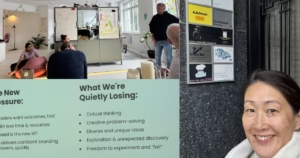
Guides Mastermind Workshop at the AJ&Smart head office in Berlin. Presentation Credit: Dee Scarano.
Why clients actually pay for this
Here’s what I’ve found organisations really want. Not more reports. Not another expert telling them what they already suspect. They want results – and results come from aligned teams making structured decisions together.
When a leadership team makes those decisions in a single focused session, it saves enormous time and money. It kills the circular meetings, the “let’s revisit this next quarter,” the slow death by calendar. And with something like sustainability, that matters even more, because sustainability is fundamentally about change. Most of the work isn’t technical at all. It’s getting people to do the thing they already agreed to do – often a commitment made at senior level that nobody quite knows how to translate into everyday company culture.
That translation gap is where I now live. And the tools I use to close it are almost entirely adjacent skills I went out of my way to learn:
- Behavioural science, to design interventions and initiatives that actually shift how people act, not just what they say.
- Design thinking and innovation tools, to turn vague pledges into concrete, workable plans – including inside our Carbon Literacy training.
- Facilitation, to help sustainability leads in large corporates design a food strategy with their entire team, so the plan has ownership baked in from day one.

The East German Ampelmännchen was designed in 1961 by traffic psychologist Margaret Mälzer. Its playful walking pose made it more memorable than West German signals, and it has since become a beloved cultural icon.
The real takeaway for consultants
If you’re an expert in your field, your knowledge is your foundation – but it is not your edge. Your edge is your ability to translate that knowledge into action inside someone else’s organisation. The most valuable thing I ever did for my business was stop trying to be a deeper expert and start becoming a better translator.
Expertise gets you in the room. Adjacent skills are what make anything actually happen once you’re there.
____________________________________________________________________________________________________
Join Us in Portugal This September 🌿
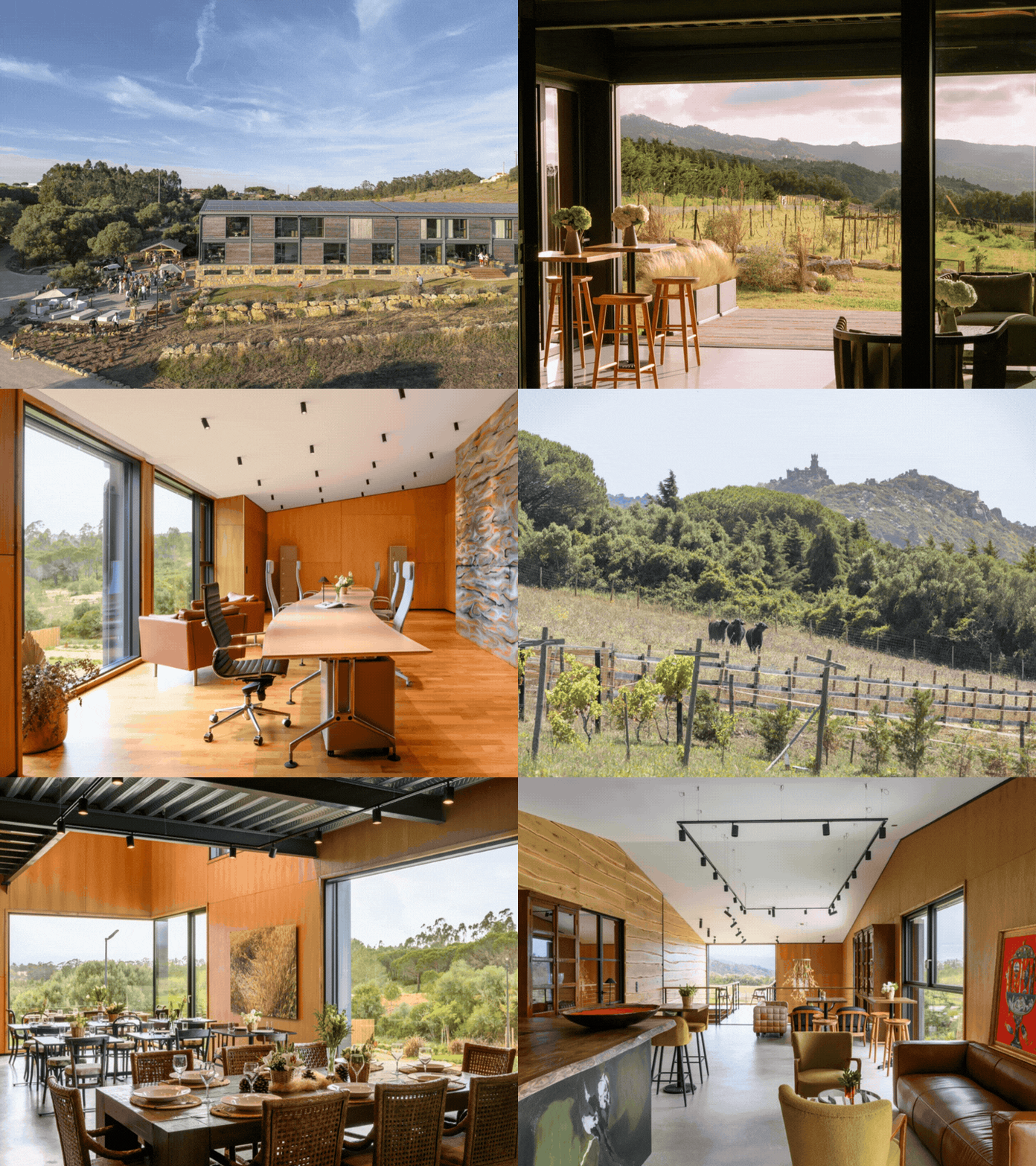
Berlin reminded me how powerful it is to step away from the day-to-day, connect with other curious minds, and create space for reflection, experimentation, and growth.
That’s exactly why I’m so excited about our upcoming Facilitation Sustainably Retreat in Portugal this September.
This retreat is designed for anyone stuck in their corporate job, looking for purpose driven career paths, and care about climate but don’t know where to start.
How to start finding purpose driven income and turn it into a business?
Whether you are a facilitator, trainer, consultant, a mum, dad, corporate professional, or a changemaker, I can help you:
- Build confidence in facilitation through learning and practicing our three core workshop methods
- Learn practical tools for group collaboration and structured decision-making
- Explore sustainability conversations in deeper, more human ways
- Connect with an inspiring international community
- Create space to think, reset, and grow
If you’ve been craving time away from the noise to reconnect with your work, your creativity, and your purpose — I’d love for you to join us.
👉 Let’s have a chat about the retreat, choose a time here that suits you.
At Future Green, we help organisations move beyond ideas into real, measurable change – from sustainable food strategy to team alignment. If your team has the plan but not the momentum, let’s talk about a Strategy Sprint.
Interested in more?
2026
I Thought I Was Hosting a Facilitation Retreat. It Became Something Much More… THE FACILITATION PRACTICE LAB SERIES 1 OF 5.
 25th September
2026
Bringing Food Sustainability into the Classroom: Future Green’s Lunch & Learn at Chinese International School
21st September2026
BEYOND THE LABEL: WHAT’S REALLY BEHIND YOUR SEAFOOD?