The Sustainability Decision Is the Contract: Why Event Planning Starts Earlier
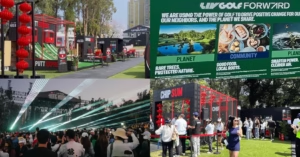
Reflections on Sustainable Procurement and Impact at a Global Sports Event
There is a moment in every event production cycle where sustainability either gets built in or bolted on. It rarely announces itself. It happens quietly – in a supplier brief, a spec sheet, a contract clause, months before gates open, long before anyone is thinking about carbon reports or post-event audits.
The organisations that get this right are not the ones with the most ambitious pledges. They are the ones with the most deliberate procurement decisions.
Working on the sustainability programme for LIV Golf Hong Kong 2026 reinforced something I have believed for a long time: the contract is where the sustainability outcome is set. Everything else is consequence.
What the Procurement Stage Actually Decides
When you appoint a fuel supplier, you are making a carbon decision. When you write a catering brief, you are making a food systems decision. When you specify sanitation infrastructure, you are making a water management decision. Most event organisers do not frame it that way — but the outcome is the same whether you frame it or not.
At LIV Golf HK 2026, we worked to specify sustainability requirements before suppliers were appointed, while leverage still existed and before budgets were locked:
- On energy and logistics: Generators and vehicles ran on a low-carbon fuel blend, specified in the contract. Ground-level logistics was electrified where possible. A third-party consultancy was commissioned to set the carbon measurement methodology before the event, not after, so the eventual figures would be defensible rather than decorative.
- On water: Sensor-enabled technology was specified in the sanitation contract, monitoring usage patterns and reducing unnecessary servicing cycles. Tanked drinking water stations were written into the catering brief, not left to default, which almost always means single-use plastic at scale.
- On waste: Three-bin recycling was required across both front-of-house and back-of-house operations. BOH compliance is the harder problem, it is invisible to attendees and often overlooked in sustainability reporting, but it is where the real volumes are.
None of these outcomes were achieved by asking on the day. They were locked in at the procurement stage, when the ask costs nothing and the outcome is certain.
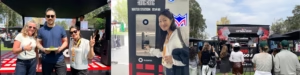
LIV Golf Hong Kong 2026 event photos
The Food Story: Resilience on the Plate
This is the part of event sustainability that gets the least attention, and in some ways the most interesting.
The SAVOUR food hospitality programme at LIV Golf HK 2026 brought together some of Hong Kong’s most respected chefs. The conversations we had with them, and the choices they made, opened up a dimension of sustainability that logistics-focused event reporting rarely captures: ingredient resilience.
Chefs working at this level think about their supply chains in ways that most event operators do not. They know which ingredients are mono-cropped and climate-vulnerable. They know which proteins carry a disproportionate environmental cost. And increasingly, they are making active choices, not for marketing reasons, but because they have seen supply disruption first-hand.
The shift away from standard white rice toward ingredients like brown rice, quinoa, and teff is a small example of a larger principle. These are not fashionable superfoods. They are crops that thrive under inconsistent rainfall, require less water, and are less susceptible to the kind of climate volatility that is increasingly disrupting agricultural supply chains. From a chef’s perspective, they also tend to be more interesting to work with as they often have higher nutritional density, more complex flavour, and better texture. The sustainability case and the culinary case, point in the same direction.
This is the food systems argument that gets lost in large-scale event catering: the same procurement decision that reduces your food carbon footprint also strengthens your supply chain resilience. An ingredient that survives a bad season is an ingredient you can rely on. An ingredient that requires vast mono-cropped acreage and consistent rainfall is a risk, commercially, environmentally, and on the plate.
We are developing this as a formal recommendation for the 2027 SAVOUR by LIV Golf brief. The goal is to work with caterers and chefs at the specification stage, the same moment that matters for energy and logistics, to embed ingredient choices that are resilient by design, not reactive to disruption.

SAVOUR by LIV Golf
On Decarbonisation and Resilience as the Same Decision
A recent conversation in the food and drink sustainability space — a webinar hosted by Forum for the Future, with senior sustainability leads from Premier Foods and Mondelez — made a point that I think applies directly to events: the industry is still searching for case studies that connect decarbonisation and resilience as two sides of the same decision. Not competing priorities. Not a trade-off. The same choice, seen through two lenses.
In event operations, the clearest example is fuel specification. Switching from standard diesel to a low-carbon fuel blend is framed as a carbon decision. It is also an energy sovereignty decision. Standard diesel is subject to geopolitical supply pressure, commodity price volatility, and logistics disruption. Renewable-compatible fuels are not tied to the same markets in the same way. An operation that runs on lower-carbon energy is also, structurally, a more resilient operation.
The same applies to food. The chef who sources from a more diverse, climate-adapted ingredient base is not just reducing food miles or carbon intensity, they are building a menu that is less exposed to supply failure. Decarbonisation and resilience, again, pointing in the same direction.
Something that one of the sustainability experts said in that webinar has stayed with me:
The food and events industries need more of these stories in the public domain, not polished impact reports, but honest accounts of procurement decisions that turned out to be the right call.

LIV Golf Hong Kong 2026 event photos
Ten Questions to Ask Before You Appoint a Supplier
If you are commissioning an event, whether a sporting event, a hospitality programme, or a food festival, these are the questions worth asking at the brief stage, before any supplier is appointed at a price that makes change difficult:
1. What fuel will generators and logistics vehicles run on?
Low-carbon fuel alternatives exist and are available in Hong Kong. They need to be specified, not assumed. Once a fuel supplier is contracted at standard diesel pricing, the conversation becomes expensive.
2. Can ground-level logistics be electrified?
Electric forklift hire and electric transport within venue boundaries is available. Ask whether it is possible before you default to diesel.
3. Who is setting your carbon methodology, and when?
A carbon figure calculated after the event by the same team that produced the event is not independently verified. Commission a third party before the event to set the framework, so the numbers mean something when you publish them.
4. Is tanked water written into the catering brief?
If it is not in the brief, the default is single-use plastic at scale. Tanked drinking water infrastructure requires lead time and specification. It will not appear without being asked for.
5. Does your sanitation supplier offer sensor-enabled water management?
This technology exists and is being deployed at event scale. It monitors usage, reduces unnecessary servicing cycles, and generates data. Ask the question.
6. Are recycling requirements specified for back-of-house as well as front-of-house?
Front-of-house bins are visible. Back-of-house compliance is where real volumes are managed and where most events quietly fail. If your recycling brief only covers what attendees see, your waste figures are incomplete.
7. Is your food and beverage offer aligned with a defined sustainable food framework?
Food is responsible for roughly 30 percent of global greenhouse gas emissions. At event scale, with a captive audience, this is one of the highest-impact decisions you will make. Are you specifying lower-carbon menus, climate-resilient ingredients, and reduced reliance on high-impact proteins, or leaving chefs to default to conventional supply chains? If it is not written into the brief, it will not show up on the plate.
8. How are diversity, equity, inclusion and workforce wellbeing reflected in supplier requirements?
Your supply chain is your workforce at scale. Are you asking suppliers about fair pay, working conditions, diversity in hiring, and safeguarding? If it is not in the contract, it is not managed and it will not show up in your impact.
9. What is your plan for communicating sustainability outcomes credibly during and after the event?
If reporting is an afterthought, it becomes marketing. If it is designed upfront, with defined metrics, data collection responsibilities, and verification, it becomes accountability. Decide early whether you are producing evidence or storytelling.
10. What legacy is this event designed to leave behind?
Most events optimise for delivery, not impact. Are you creating local supplier opportunities, infrastructure improvements, behaviour change, or partnerships that last beyond the event? If there is no defined legacy objective, there will be no legacy outcome.
None of these are difficult questions. They are procurement questions. And the answers, collectively, are what a genuine sustainability programme looks like in practice, not as a report, but as a set of contracts.
🌿 Want to embed sustainability into your events? Let’s talk
Whether you’re planning a sporting event, festival, or corporate experience, the challenge is the same: turning ideas into action.
At Future Green, we design practical, scalable solutions, from reusable systems and waste strategy to fan engagement and tracking impact.
Looking to reduce waste and improve your event operations?
Book a call now or email us at hello@futuregreen.global

Connect with Us:
Contact Us: Got questions or ideas? Email us at hello@futuregreen.global.
Together, we’re not just talking about a sustainable future; we’re building it. Let’s make every meal a story worth telling.
Stay green, stay inspired.
Future Green Team
Interested in more?
2026
Why I Teach Entrepreneurs to Run Strategic Workshops (And What Happened at Our Retreat) — THE FACILITATION PRACTICE LAB SERIES. BLOG 2 OF 5, PART 1 OF 2.
 8th October
2026
I Thought I Was Hosting a Facilitation Retreat. It Became Something Much More… THE FACILITATION PRACTICE LAB SERIES 1 OF 5.
25th September2026
Bringing Food Sustainability into the Classroom: Future Green’s Lunch & Learn at Chinese International School