The Strategic Sprint: From the Messy Middle to a Roadmap You Can Actually Use – THE FACILITATION PRACTICE LAB SERIES 3 OF 5, PART 2 OF 2.
Part of a learning series: How to Run a Strategy Workshop
This blog is part of a series sharing our learnings from the Future Green Facilitation Practice Lab in Sintra, Portugal.
In Part 1, we did the heavy lifting: purpose, a two-year goal, guiding principles, and the “can we?” questions that move a strategy from idealistic to realistic. That’s the foundation. Brain-aching by design, and deliberately done first while everyone’s fresh.
Part 2 is where that thinking becomes real projects. Prioritised, planned, and committed to. This is the half people find most satisfying, because they can finally see the output taking shape.

IT STARTS BEFORE DAY ONE: THE CHALLENGE MAP
The ideation in this sprint is never abstract, and that’s on purpose. Before the workshop even begins, we interview the leaders to understand the outcomes they want. From those conversations, we build a structured artefact we call the Challenge Map: every high-level stakeholder and the real challenges they’re facing, in their own words. It’s the beginning of:
1) the diagnosis! (which leads to: part 2) the guiding policies, and finally 3) coherent actions, which we will discuss below. Never skip your interviews, facilitators! What lies there are your best pain points to uncover.
Real examples from the map:
“Our clients don’t know where we stand on sustainability.”
“Our team struggles to understand why sustainability matters, and isn’t aware of practical solutions like carbon labelling on menus.”
“Our teams work in silos and can’t collaborate meaningfully.”
Participants read the Challenge Map as background before they arrive. So by the time they walk in, they’re not inventing problems, they’re primed with documented, real ones to solve. It’s the same principle that runs through everything I teach:
Although we know not everyone attending workshops does ‘homework’, I also build in a slot for reading and adding to the map.
INTO THE MESSY MIDDLE (AND THE GROAN ZONE)
With the two-year goal clear and a real challenge named, we open up. We get creative. I use Sam Kraner’s diamond from his decision-making book, Facilitator’s Guide to Participatory Decision-Making, to talk about the messy middle and the groan zone. The part where ideas are allowed to be plentiful, unfinished, and a bit chaotic.
 The diamond of participation, Sam Kraner.
This matters because people instinctively want to jump to the “right” answer. The diamond permits them to diverge first, to put everything out there, before we narrow down and converge on solutions. Naming the messy middle as a normal, necessary stage is half of what makes it work.
LIGHTNING DEMO
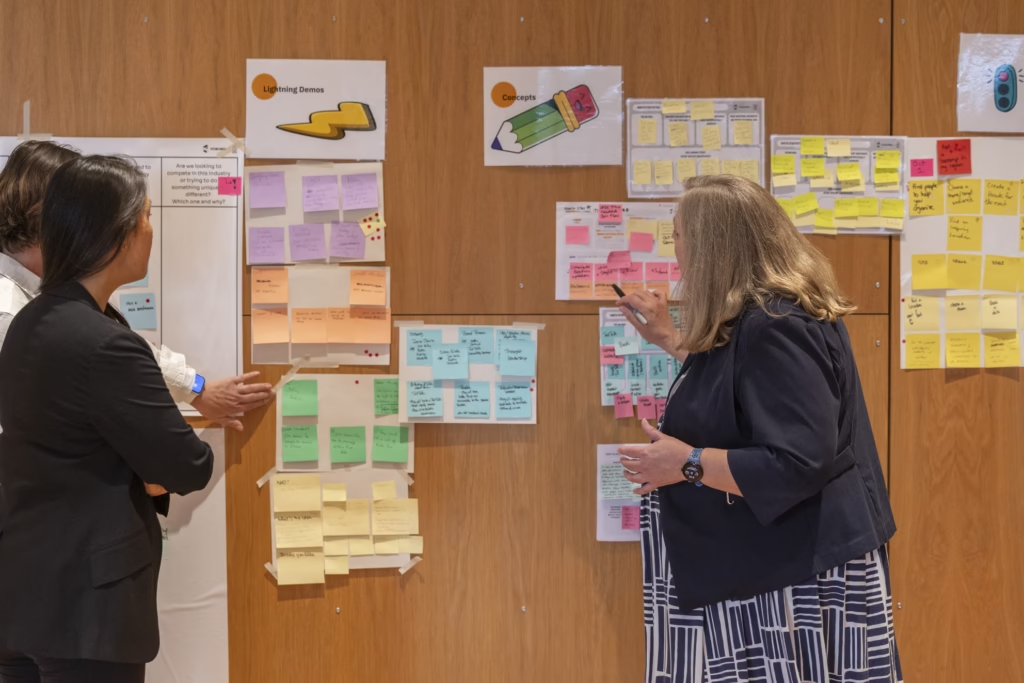
The first move into divergence is a structured inspiration hunt. Everyone researches how other businesses, inside or outside their industry, have solved the kind of problem they’re facing. Each person can look at three, but they only get sixty seconds to share one favourite with the group: what they saw, and why they liked it.
The spirit of it: don’t reinvent the wheel. Borrow brilliance, then add your own flavour. Fast, democratic, and it fills the room with real-world reference points instead of blank-page guessing.
CONCEPT CARDS
Lightning demo gives you raw inspiration. Concept cards give you a structured way to turn it into designed projects and initiatives, drawing directly on what people found in their research.
The scaffolding again:
CONVERGING: FROM MANY IDEAS TO REAL COMMITMENTS
Up to this point, most of the work has been done “together alone”. People think and create individually, then come together to vote. It’s how you get the quality of a whole room without the loudest voice dominating.
Now the room finally opens up into discussion.
LAYERED VOTING
Especially with larger groups, we vote in layers to narrow the field. This is where people present, and almost pitch, their concepts, because they’re choosing what they’ll actually commit to going forward. We teach democratic voting, while still making room for a decision-maker. (The finer logistics of that are a workshop-craft topic for another day).
 THE ROADMAP: The winning ideas get stuck onto a roadmap. This is the output we visualised from day one, now filling in for real.
PLANORAMA
Then we draw on a method called Planorama to pressure-test execution: the steps involved, the resources we have. Dates, limitations, and budgets. Projects get mapped in context against each other along a timeline on the wall, so you can see the whole picture, not just one initiative in isolation:
 Planorama in full motion.
WHAT THEY WALK OUT WITH
By the end, the strategy is roughly 70 to 80% ready, a living roadmap of prioritised, planned projects, built from real stakeholder challenges, and the confidence to keep shaping it back at the office. Not a document that sits in a drawer. A plan with momentum behind it.
That’s the strategic sprint. It’s structured, it’s demanding, and when it’s facilitated well, it does something a report never can. It gets a room of people to think hard, decide together, and leave genuinely ready to act.
 Wine tasting evening was the best after completing our Roadmap (Last part of Strategy Sprint)
💡 WANT TO BRING A STRATEGY SPRINT TO YOUR TEAM?
You do not need to be a facilitator to benefit from the approach we practised in Sintra.
At Future Green, we use Strategy Sprints to help leadership teams tackle complex challenges, align around priorities and turn ideas into a practical roadmap for action.
Whether you are developing a sustainability strategy, launching a new initiative, or aligning stakeholders, a facilitated Strategy Sprint can help your team move from discussion to decisions and action.
→ Find out how a Future Green Strategy Sprint could work for your team –

Keep up to plate
Fortnightly stories from Asia's go-to food sustainability consultancy
Interested in more?
2026
Beyond Good Intentions: How Businesses Can Make a Real Difference in Their Communities
 30th October
2026
How to Run a Retreat for Facilitators and Consultants – THE FACILITATION PRACTICE LAB SERIES 5 OF 5.
30th October2026
Why Great Teams Don’t Think Alike – THE FACILITATION PRACTICE LAB SERIES. BLOG 4 OF 5.