Why I Teach Entrepreneurs to Run Strategic Workshops (And What Happened at Our Retreat) — THE FACILITATION PRACTICE LAB SERIES. BLOG 2 OF 5, PART 1 OF 2.

Part of a learning series: How to Run a Strategy Workshop
This blog is part of a series sharing our learnings from the Future Green Facilitation Practice Lab in Sintra, Portugal. The series starts with the bigger picture: How to Run a Strategy Workshop. The framework that holds the programme together. From there, we’ll explore the practical tools, facilitation techniques, and lessons that bring each part of the process to life.
THE WORK I WAS NEVER SUPPOSED TO DO
For years, I couldn’t get a job.
Not because I wasn’t capable. Because I was a trailing spouse, following my husband’s work around the world, raising three children who were born on three different continents. Traditional nine-to-five work was simply not open to me. Every time we moved, I started again from nothing.
I didn’t see a way through. Starting my own business had genuinely never crossed my mind, not once, until a woman I met at a networking event told me I should. She saw something I couldn’t see in myself yet.
That nudge changed everything. And it’s why I now do the same for other people:
The subjects I teach have changed over the years. The teaching has been the constant. It’s the thing I love most, and, it turns out, the thing I’m best at.

Beautiful landscape of Sintra, Portugal.
THE BEST WORK WEEK OF MY LIFE
This autumn I ran a retreat at Quinta da Bufala in Sintra, teaching a room full of entrepreneurs, each from a different industry, how to run a strategic sprint workshop. If I had to point to the work that lights me up most, this was it. Helping other people reach an outcome they didn’t think they could.
The week was built around one simple promise. By the end, every person would be able to run an AJ&Smart strategy sprint, the whole structured workshop, and apply it to their own business. Not watch me do it. Do it themselves.
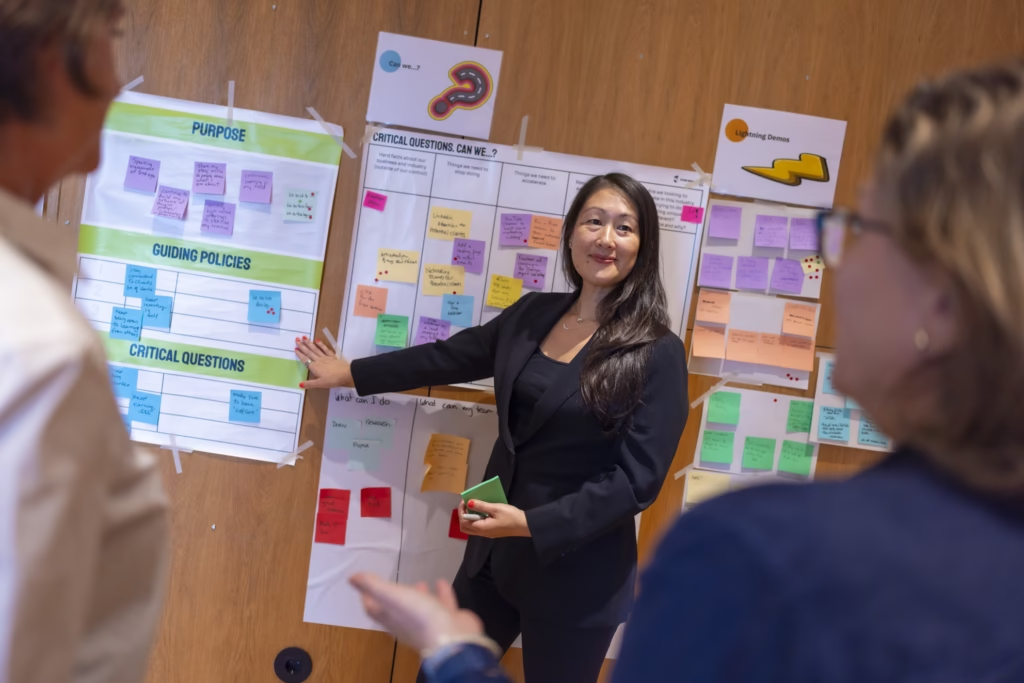
Heidi teaching entrepreneurs how to run a strategic sprint workshop.
Here’s how the days worked, because the rhythm is the method:
-Mornings: I demonstrated. I’d run one section of the sprint in order, sharing exactly how I deliver it to real clients, and the real questions that come up in the room when you’re actually facilitating. Tangible, not theoretical.
-A long, gorgeous farm-to-table lunch. (Non-negotiable.)
-Afternoons: they delivered. People self-volunteered to run the section they’d just seen, in their own flavour. I call this building tools for your toolbox. One participant, fresh from her Lego Serious Play training, mashed it up with her favourite Liberating Structures technique to deliver her section. That creative remixing is exactly what I want to see.
-4 to 5pm, “level up”: something business-related but off-sprint. Facebook ads, a new collaboration tool, pitching practice, and a wellness panel, because I don’t believe work, mind and body are separate things.
-Two evenings of wine tasting. My idea of what a great working week looks like.
A detail I loved in the feedback: we visualised the end output, the roadmap, from day one and worked toward it until day five. Watching it slowly take shape built real confidence. And because everyone came from a different industry, the quality of the thinking went up, not down.
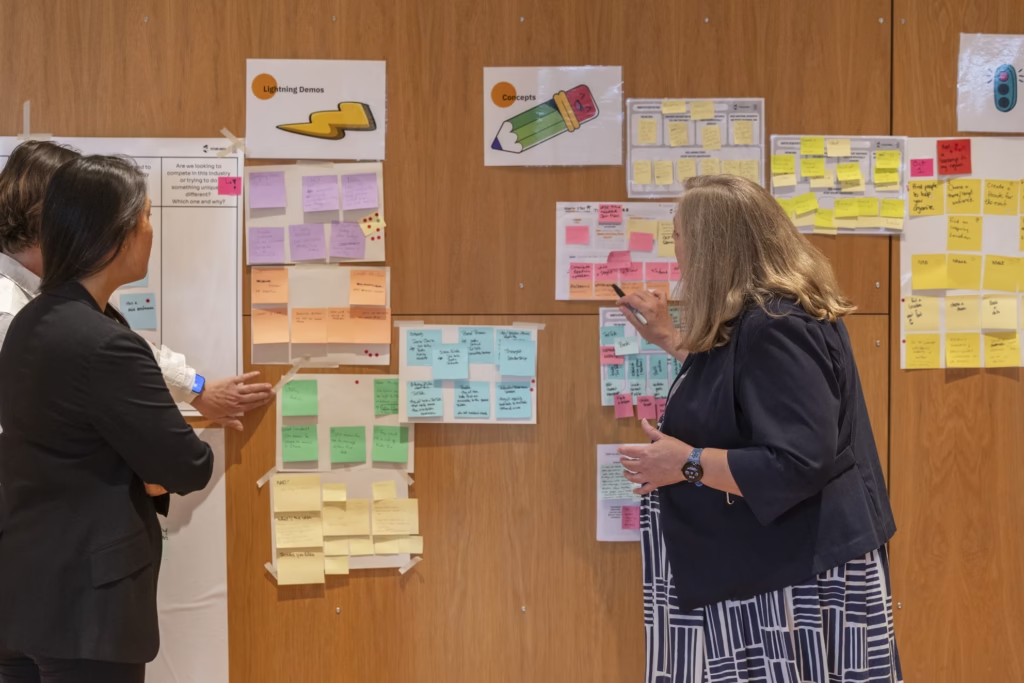
Visualising the roadmap
THE PART WHERE YOUR BRAIN HURTS
The sprint opens with the heavy lifting. Four big pieces of high-level strategic thinking, done in order, right at the start while everyone’s fresh. I tell people honestly: this is the hardest mental work of the whole week, and your brain is supposed to ache. We front-load it on purpose.
The four, in order and inspired by author Richard Rumelt’s Good Strategy Bad Strategy:
- PURPOSE
Why the company exists, we build it from three sentence stems: “We exist to…”, “We do this for…”, and “We do this by…”.
- TWO-YEAR GOAL
Where you’re heading. Not five years, that’s too far off, and you’ll likely have staff churn by then. Not one year, that’s too short to ship real projects. Two years is the sweet spot, a ‘proximate objective’. This isn’t my preference, it’s drawn from Richard Rumelt’s Good Strategy Bad Strategy. We start the sticky with “In two years we will…”, show plenty of examples pulled from real corporate reports, then let people write their own, as many as they like, as creatively as they like.
- GUIDING PRINCIPLES
How you live your values, your working approach, almost a set of operating commitments. They come in different shapes, which is what makes them click. Three examples from the room:
-A mindset: if you take on a project, go all in, because half-in means it won’t get finished properly.
-A methodology: use behaviour science as your approach to move the business away from business as usual.
-A behaviour rule: only bring a problem to your line manager if you’ve also thought through a possible solution.
- THE “CAN WE?” QUESTIONS
This is where we move from idealistic to realistic. We phrase critical questions so they can be answered yes, no, or potentially. For example: “Can we realistically procure 100% cage-free eggs by the end of 2027?”
That single question surfaces supplier availability, market and regional constraints, all the things that decide whether a strategy actually survives contact with reality. They come out of a critical-questions framework, a poster with columns like “What are some hard facts about the industry?”
Important:
These questions are raised early and deliberately left open. We don’t answer them in the room. They’re the things to investigate more deeply later, when you’re designing actual projects.
-Part of good facilitation is knowing what not to resolve on the day.
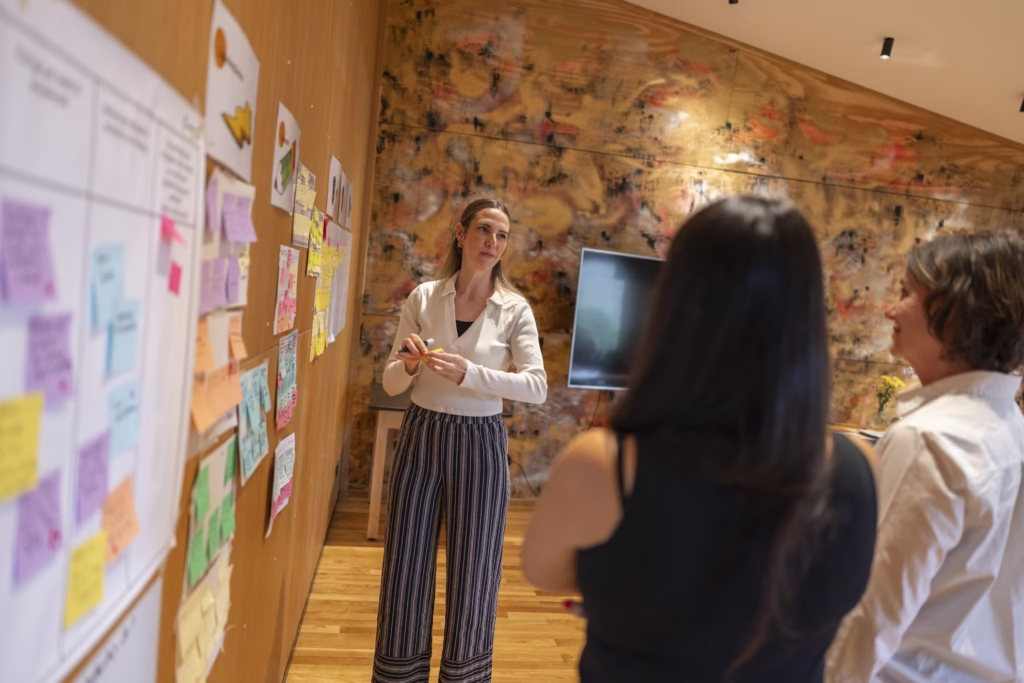
Practicing and asking ourselves the right questions.
TOP TIPS FOR PREP: THREE THINGS THAT MAKE THIS WORK (FOR THE FACILITATORS READING)
Woven through all of the above are the craft habits that separate a sprint that lands from one that stalls:
– Reduce cognitive load. Pre-print sentence stems onto long horizontal sticky notes in advance, so people spend their energy on the content, not wrestling with the process.
– Always give examples before you ask people to do the work. It lowers the stakes and it’s why a room of people from completely different industries could all take part.
– Know what not to resolve in the room. Capture it, park it, move on.
AND ONE HONEST EXPECTATION TO SET
By the end of the week, your strategy is roughly 70 to 80% ready. That’s the point, not a shortfall. It’s a strong, usable draft with real momentum behind it, and it’s meant to be iterated once you’re back in your office, tested against reality and refined with your team. Nobody leaves with a stone tablet. They leave with a living strategy and the confidence to keep shaping it.

Business Chemistry – one of my fave team collaboration warm-ups led by Amy
💡 WANT TO BRING A STRATEGY SPRINT TO YOUR TEAM?
You do not need to be a facilitator to benefit from the approach we practised in Sintra.
At Future Green, we use Strategy Sprints to help leadership teams tackle complex challenges, align around priorities and turn ideas into a practical roadmap for action.
Whether you are developing a sustainability strategy, launching a new initiative, or aligning stakeholders, a facilitated Strategy Sprint can help your team move from discussion to decisions and action.
→ Find out how a Future Green Strategy Sprint could work for your team –
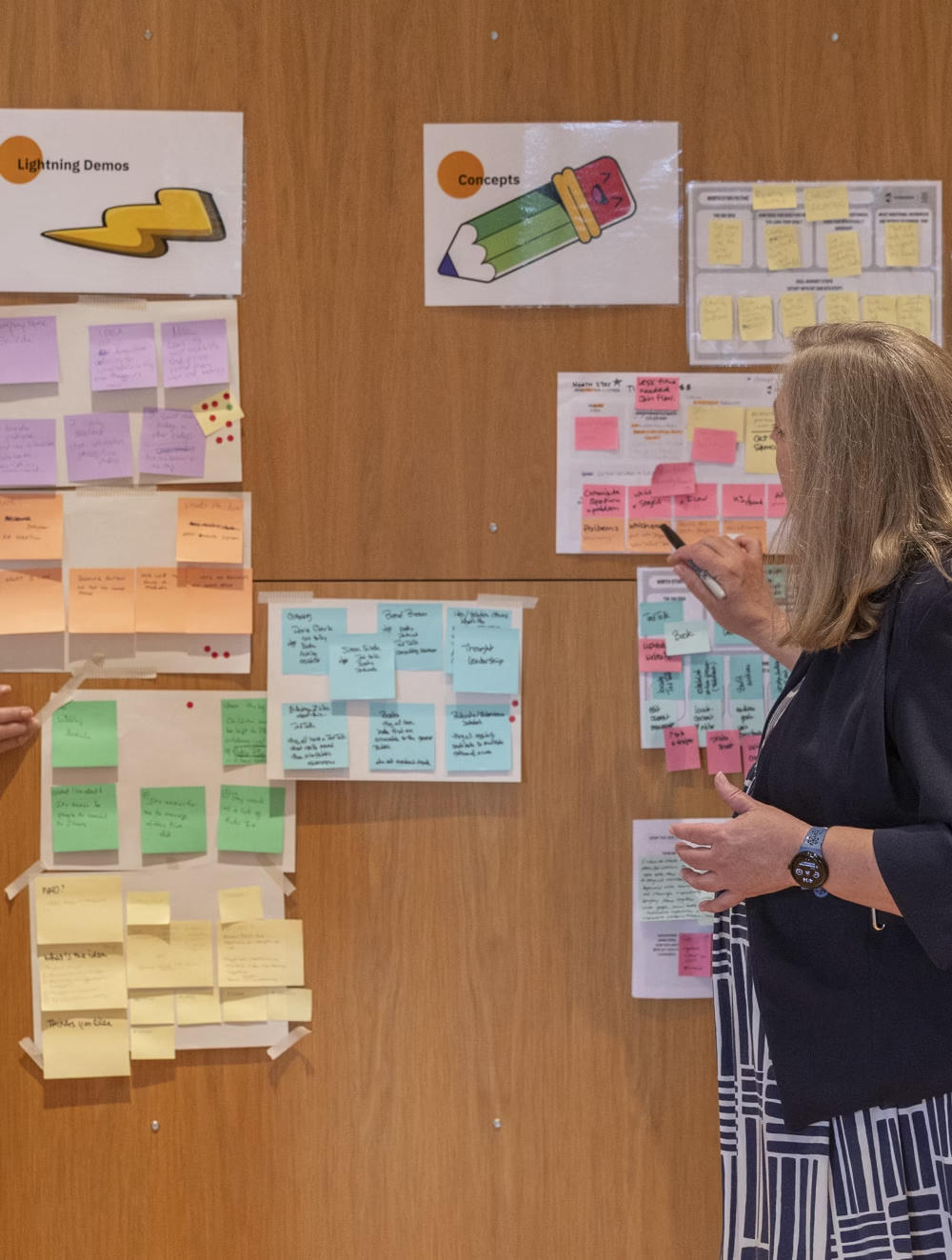
The Strategic Sprint, Part 2: From the Messy Middle to a Roadmap You Can Actually Use – THE FACILITATION PRACTICE LAB SERIES. BLOG 3 OF 5, PART 2 OF 2.
Moving from strategic foundations to ideas, priorities and a practical roadmap.
Interested in more?
2026
I Thought I Was Hosting a Facilitation Retreat. It Became Something Much More… THE FACILITATION PRACTICE LAB SERIES 1 OF 5.
 25th September
2026
Bringing Food Sustainability into the Classroom: Future Green’s Lunch & Learn at Chinese International School
21st September2026
BEYOND THE LABEL: WHAT’S REALLY BEHIND YOUR SEAFOOD?