When to Take Off Your Trainer Hat and Put On Your Facilitator Hat


Carbon Literacy Project Lightening Decision Jam Workshop at Autotrader Head Office London. Photo credit: Otto Mendelsson
Last week I found myself back in central London, facilitating a workshop at Autotrader’s offices in Covent Garden, London.
The last time I regularly worked in this part of London, I was a university student working as a part-time retail assistant. Fast forward a couple of decades and I’m now standing in a boardroom talking about climate action, organisational change, and facilitation.
Life has a funny way of coming full circle.
The workshop brought together twelve participants from a wonderfully mixed group of backgrounds: Carbon Literacy trainers, sustainability professionals, local authority representatives, educators, consultants, and members of the AJ&Smart facilitation community.

Lightening Decision Jam workshop. Photo credit: Otto Mendelsson
The challenge we explored was one that I hear repeatedly from organisations:
How do we turn Carbon Literacy pledges into real organisational change?
Because here’s the reality.
Most Carbon Literacy programmes do a brilliant job of increasing awareness. People leave motivated. They understand the urgency. They want to do something.
Certificates are awarded.
Pledges are made.
And then six months later…
Nothing much has happened.
The motivation fades. Pledges get buried under competing priorities. Sustainability becomes another item on an already overloaded to-do list.
The question I wanted to explore was whether facilitation could help bridge that gap between commitment and implementation.

Starting the day with icebreakers to create psychological safety. Photo credit: Otto Mendelsson
Which Hat Are You Wearing?
One of the most interesting conversations during the workshop centred around a simple question:
Which hat are you wearing?
As Carbon Literacy trainers, we spend much of our time wearing the trainer hat.
We’re sharing information. Teaching. Explaining. Building awareness. Helping people understand climate science, carbon emissions, and the role they can play in creating change.
At this stage, information is essential.
But something shifts when we reach the pledge stage. At that point, people usually don’t need more information. They already know. They understand the challenge and they want to contribute.
What they need is help navigating the messy reality of implementation.
Questions start to emerge:
- Who owns this action?
- How do we get leadership buy-in?
- What happens when sustainability clashes with commercial priorities?
- How do we create accountability?
- What can I actually influence?
This is where the facilitator hat becomes essential.

LDJ facilitation workshop exercises.
Facilitation isn’t about providing answers.
It’s about holding the space for people to surface challenges, explore barriers, make decisions, and uncover solutions together.
As facilitators, our role shifts from teaching people what to think towards helping them work out what to do.
Carbon Literacy helps people understand why change is needed.
Facilitation helps people figure out how to make that change happen.
And I believe that distinction is often missing from many sustainability programmes.

Participants taking part in ‘quiet time’ to allow ideas and thoughts to flow. Photo credit: Otto Mendelsson
Exploring Why Pledges Get Stuck
To investigate this challenge, I ran a condensed version of Lightning Decision Jam (LDJ), one of my favourite facilitation methods, originally developed by AJ&Smart and adapted through my own sustainability work.

The Diamond of Participatory Decision Making – Sam Kaner et al / Graphic adapted from AJ&Smart.
Normally I’d run a full implementation workshop over around three hours, but for this session we compressed it into ninety minutes.
The principles behind the method are deceptively simple:
- Structured, time-boxed activities
- Thinking individually before group discussion (“together alone”)
- Visualising ideas rather than relying on conversation alone
- Prioritising actions and assigning accountability
Rather than jumping straight into solutions, we began with a Sailboat exercise to explore what is helping sustainability move forward and what is holding it back.
The positives were encouraging.
Participants shared examples of leadership commitment, growing sustainability teams, increased awareness, and employees who genuinely want to contribute.

Lightning Decision Jam Activity. Photo credit: Otto Mendelsson
The challenges, however, were strikingly familiar.
- Sustainability isn’t seen as a business priority when pressures increase.
- Ownership is unclear.
- Resources are limited.
- Staff feel powerless to influence decisions.
- Sustainability gets added to existing workloads.
- Meetings generate discussion but not decisions.
- Long-term benefits struggle to compete with short-term costs.
- Leadership commitment doesn’t always translate into action.

Categorising barriers to progress. Photo credit: Otto Mendelsson
From Problems to Possibilities
Once the barriers were visible, we shifted into solution mode using “How Might We” questions.
Some of the questions generated included:
- How might we ensure leaders prioritise sustainability over convenience?
- How might we empower people to take meaningful action?
- How might we improve decision-making processes around sustainability?

‘How Might We’ Activity. Photo credit: Otto Mendelsson
Using an Impact versus Effort Matrix, participants prioritised the solutions most likely to create change.
What I found fascinating was that the strongest ideas weren’t technical sustainability interventions.
They focused on people.
Leadership.
Accountability.
Decision-making.
Ownership.
Creating space for participation.
The conversation reinforced something I’ve observed repeatedly over the years:
Most sustainability challenges are not information problems. They’re implementation problems.

Impact versus Effort Matrix activity. Photo credit: Otto Mendelsson
Why Facilitation Belongs in Sustainability
This workshop reminded me why I care so deeply about facilitation.
I’ve spent years working across sustainability, innovation, food systems, and organisational change, and I keep seeing the same pattern.
People care.
People want to help.
People understand the issues.
Yet progress often stalls because organisations haven’t created the conditions for action.
That’s where facilitation comes in.
A good facilitator helps groups move beyond discussion.
Beyond information sharing.
Beyond good intentions.
Towards decisions, ownership, and action.
Carbon Literacy training lays the foundation.
Facilitation helps build the bridge.
For organisations that have already invested in Carbon Literacy but feel frustrated by a lack of progress on pledges, facilitation may be the missing piece.
That, ultimately, is what this workshop was about: not simply increasing Carbon Literacy, but creating the conditions for climate action to take root and grow.

[Left] Ending the day with drinks and networking. [Right] Heidi and Otto from CLP outside Autotrader’s head office in London.
A Few Personal Highlights
The trip wasn’t all workshops and sticky notes.
While in London I also visited IMA, the beautiful vegan restaurant founded by Jessica, who previously interned with us.

Lunch at IMA with Jessica and friends and family.
Anyone who has worked in hospitality knows just how tough that industry can be. Seeing Jessica build something so thoughtful, values-led, and successful was genuinely inspiring. It reminded me that meaningful work often takes years of persistence behind the scenes before anyone notices the results.

Vegan dishes at IMA.
The week also coincided with my son completing his first year at university.
As any parent will understand, those milestones have a habit of making you pause and reflect.
Both experiences felt strangely connected to the workshop itself.
Whether we’re building a business, completing a degree, changing an organisation, or driving sustainability initiatives, meaningful progress rarely happens because of one big moment.
It happens because people keep showing up.
One decision.
One conversation.
One action at a time.
And that’s ultimately what this workshop was about.
Not simply increasing Carbon Literacy.
But creating the conditions for climate action to take root and grow.
Books That Continue to Influence My Facilitation Work
Many of the methods I use draw inspiration from thinkers who have shaped the facilitation and systems thinking world, including:
- Good Strategy Bad Strategy – Richard P. Rumelt
- The Power of Moments – Chip Heath and Dan Heath
- The Lean Startup – Eric Ries
- Managing Transitions – William Bridges
- Sprint – Braden Kowitz, Jake Knapp and John Zeratsky
- The Art of Gathering – Priya Parker

Recommended facilitation and workshop books.
These books continue to influence how I design workshops that help people move from discussion into meaningful action.
Final Thoughts
Reflecting on the workshop, I was reminded that creating change is rarely about having more information. More often, it’s about creating the right conditions for people to turn good intentions into meaningful action.
Carbon Literacy helps people understand the challenge. Facilitation helps them navigate the path forward.
If we want sustainability pledges to become lasting organisational change, we need to move beyond awareness alone and invest in the conversations, decisions, and accountability that make action possible. Because real progress doesn’t happen through a single workshop or certificate—it happens when people are empowered to take the next step, and then the one after that.
If you’re curious to learn the three core workshop recipes that I use, I’ll be running a training session in the coming weeks.
I’ll be sharing more soon, but in the meantime, download my top 10 tips for facilitation.

____________________________________________________________________________________________________
Join Us in Portugal This September 🌿
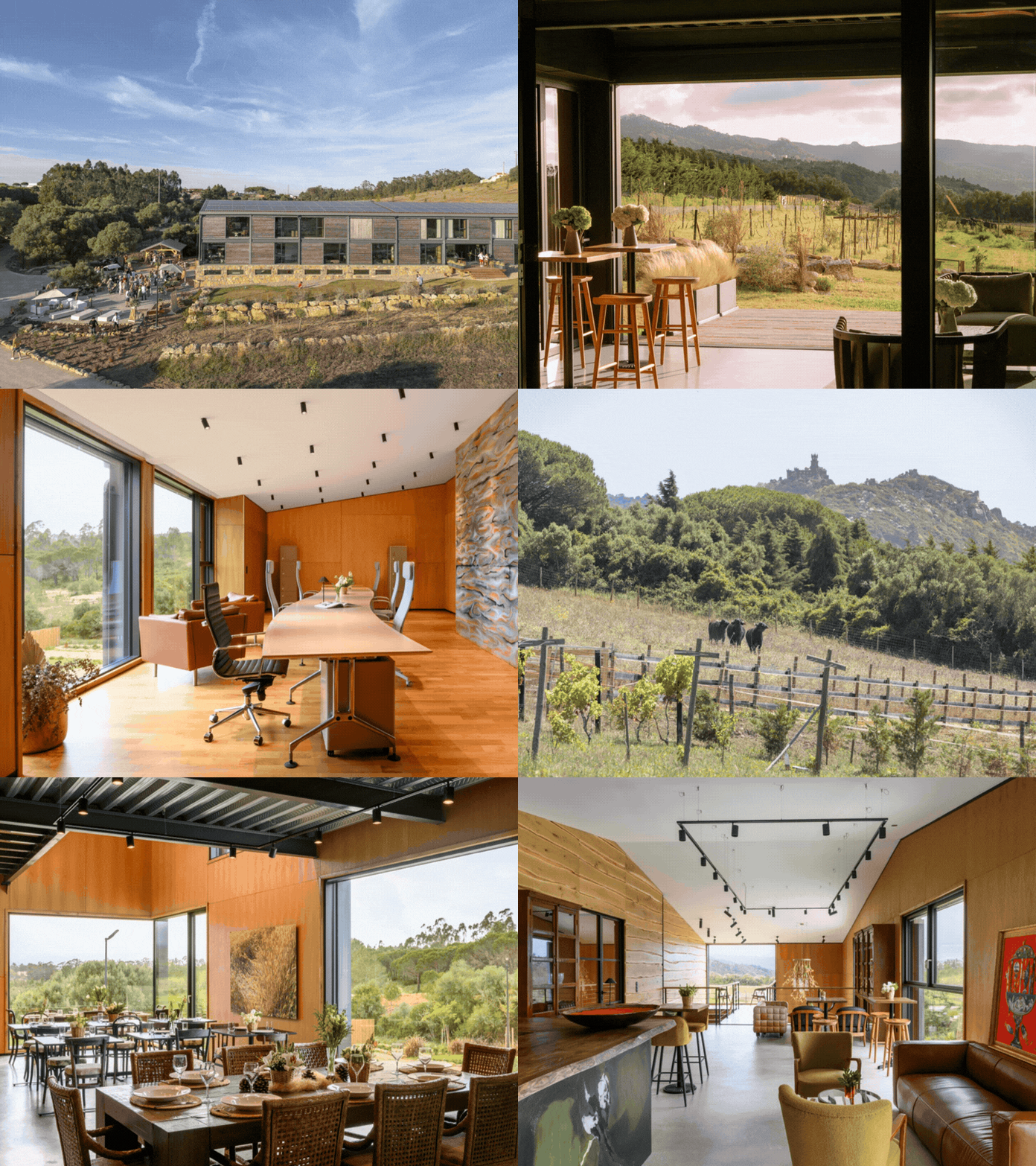
Again and again, I see organisations invest heavily in awareness, training, and strategy, only to struggle when it comes to implementation. The challenge is rarely a lack of knowledge. More often, it’s a lack of the conversations, decision-making processes, and accountability needed to turn good intentions into action.
That’s why I’m so excited about our upcoming Facilitation Sustainably Retreat in Portugal this September.
Over five immersive days, we’ll explore the facilitation methods and workshop recipes that I use to help groups move beyond discussion and towards meaningful action.
Whether you are a facilitator, trainer, consultant, a parent, corporate professional, or a changemaker, I can help you:
- Build confidence in facilitation through learning and practicing our three core workshop methods
- Learn practical tools for group collaboration and structured decision-making
- Explore sustainability conversations in deeper, more human ways
- Connect with an inspiring international community
- Create space to think, reset, and grow
If you’ve been craving time away from the noise to reconnect with your work, your creativity, and your purpose — I’d love for you to join us.
👉 Let’s have a chat about the retreat, choose a time here that suits you.
At Future Green, we help organisations move beyond ideas into real, measurable change – from sustainable food strategy to team alignment. If your team has the plan but not the momentum, let’s talk about a Strategy Sprint.
