From Forest to Fork: Why Deforestation-Free Food Matters for Every Business
Our global community coming together to make deforestation-free food a business priority.
At our last Future Green Members Meetup of the year, sustainability leaders, suppliers, caterers and food businesses gathered to tackle a topic that can feel distant, technical, and overwhelming:
Deforestation-free commodities.
On the surface, deforestation might seem like an issue happening far away — in the Amazon, Southeast Asia, or Central Africa. But as this session quickly made clear, deforestation is deeply embedded in our global food system, and it affects every business that buys, sells, or serves food.
From beef and soy to cocoa, coffee, palm oil and rubber, agricultural commodities are responsible for around 75% of global deforestation. And with new regulations like the EU Deforestation Regulation (EUDR) accelerating change, businesses everywhere — including in Asia — need to understand what’s coming.
This meetup wasn’t about fear or compliance panic. It was about clarity, connection, and solutions.
🌍 THE EU DEFORESTATION REGULATION: WHAT’S ACTUALLY CHANGING?
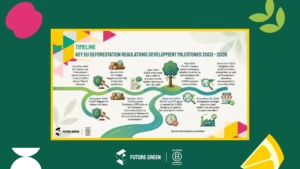
Understanding the EU Deforestation Regulation: why traceability and transparency now matter for every supply chain.
We began by breaking down the EUDR — one of the most significant global policies aimed at tackling commodity-driven deforestation.
The regulation requires companies placing certain products on the EU market to prove that they are:
- Deforestation-free (no forest cleared after 31 December 2020)
- Legally produced (meeting local environmental and labour laws)
- Fully traceable, right down to farm-level geolocation data
The seven covered commodities — cattle, cocoa, coffee, palm oil, rubber, soy and timber — sit at the heart of many food supply chains. Importantly, the regulation also applies to products made from these commodities, not just the raw ingredients.
While timelines have shifted, the direction of travel is clear. Compliance requirements are expected to come into force from 2026 onwards, with pressure cascading through global supply chains.
And even if you’re not exporting to Europe, the implications still matter.
📊 FROM FORESTS TO SCOPE 3: MAKING THE CONNECTION
One of the biggest “aha” moments for many members was understanding how deforestation links directly to Scope 3 emissions — the hardest-to-measure, yet often largest, part of a company’s carbon footprint.
Food and drink procurement typically sits squarely in Scope 3. That means:
- Where ingredients are grown
- How animals are fed
- Whether forests were cleared to produce those inputs
…all influence a company’s climate impact.
Even a restaurant in Hong Kong serving beef may be indirectly linked to deforestation through imported animal feed like soy. Transparency is no longer optional — it’s becoming a baseline expectation for credible ESG reporting.
🌱 FROM PROBLEM TO POSSIBILITY: A REGENERATIVE SOLUTION
From buzzword to breakthrough: what deforestation-free food looks like in practice.
With the challenge clearly laid out, the session shifted to something equally important: what good looks like in practice.
We were joined by our guest speaker Anita Vogel from Lionheart Farms, who shared a powerful, on-the-ground example of how food production can actively reverse environmental and social harm.
Lionheart Farms operates in South Palawan, Philippines, where they’ve planted over 600,000 coconut palms using regenerative agriculture — restoring land rather than degrading it.
Instead of extracting value, their model focuses on:
- 🌴 Planting trees, not clearing forests
- 🌾 Improving soil health and biodiversity
- 👩🏽🌾 Creating dignified livelihoods for over 1,500 farming families
- 🔍 Full traceability and documentation, future-proofed for regulations like EUDR
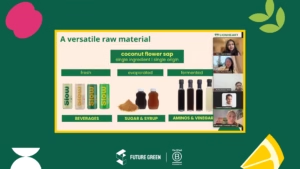
One tree, many possibilities — turning coconut flower sap into low-impact, high-value ingredients.
Perhaps most striking was their innovative use of coconut flower sap — harvested without cutting down trees or producing coconuts — to create sweeteners, vinegars, seasonings and beverages.
The result? A low-footprint, nutrient-rich alternative to products like soy sauce and refined sugar — without the hidden deforestation risk.
🤝 PEOPLE, PLANET, AND PROFIT — TOGETHER
Lionheart’s story challenged a common assumption: that sustainable, regenerative products must always cost more.
By cutting out middlemen and building direct farm-to-market models, Anita explained how Lionheart can often compete — and even undercut — conventional alternatives, while paying farmers two to three times the living wage.
This is what shared value looks like in action:
- Farmers earn more
- Buyers gain transparency and resilience
- Ecosystems recover rather than collapse
It’s not easy. It’s not fast. But it is possible.
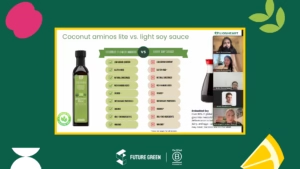
A simple swap with powerful impact: rethinking everyday ingredients through a deforestation-free lens.
🏆 LEARNING THROUGH PLAY: THE DEFORESTATION QUIZ
No Future Green Meetup would be complete without a bit of fun. The session wrapped up with a live quiz testing participants knowledge on:
- EUDR commodities
- Traceability requirements
- Food system emissions
- Regenerative farming principles
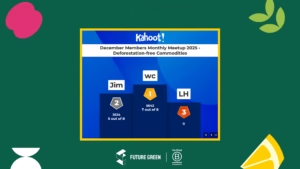
Learning through play — testing our knowledge and celebrating progress together.
Congratulations to our quiz winner – Warton Chieng from Hakkobako, who walked away with a USD $50 voucher for Lionheart’s regenerative products.
🌍 WHY THIS MATTERS — NOW MORE THAN EVER
Deforestation isn’t just an environmental issue. It’s a business risk, a climate risk, and a social justice issue.
But as this meetup showed, it’s also an opportunity:
- To rethink procurement
- To support better farming models
- To future-proof supply chains
- To lead with credibility, not greenwashing
When businesses choose deforestation-free, transparent, regenerative ingredients, they don’t just reduce harm — they actively contribute to a food system that works for people and the planet.
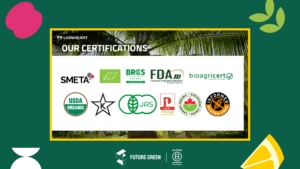
Proof behind the purpose: transparency, traceability, and trust built into every product.
💚 KEEP THE CONVERSATION GOING
With our last Meetup of the year, we would like to remind you that if you’re navigating sustainable procurement, Scope 3 emissions, or food system transformation, you don’t have to do it alone.
👉Discover Lionheart Farms’ regenerative sourcing model and see how deforestation-free food can strengthen your supply chain, build trust with customers, and deliver real impact for the planet.
👉 Explore Cocoes’ coconut flower sap products, crafted through regenerative, deforestation-free farming
👉 Join the Future Green Membership for practical tools, expert insights, and a community driving real change
📅 Book a discovery call to explore how we can support your sustainability journey
Because protecting forests isn’t someone else’s responsibility — it’s all of ours.
