🌊 Less Plastic, More Sense: Why Reduce and Reuse Matter More Than Recycling
In this Future Bites podcast episode, we sit down with Dana Winograd, Executive Director of Plastic Free Seas and a long-time friend and supporter of Future Green, to unpack one of the most pressing environmental challenges of our time: plastic pollution.
With more than a decade spent tackling plastic waste across Hong Kong, Dana brings deep, real-world insight from beaches, classrooms, corporate boardrooms, and policy discussions. Her work has helped thousands of students, businesses, and community members move beyond awareness — and into meaningful, practical action.
Listen to the full podcast here.
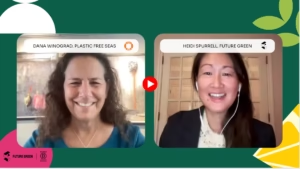
Heidi and Dana unpack why reducing and reusing plastic matters more than relying on recycling alone.
From Community Concern to Citywide Impact
Dana’s journey into environmental education didn’t begin in sustainability. After moving to Hong Kong over 30 years ago, she became involved in a local community green group in Discovery Bay. What began as concern over plastic washing up on nearby beaches soon revealed a much bigger issue — and a significant lack of public understanding.
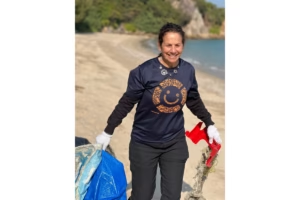
What began as concern on one beach sparked a city-wide movement to tackle plastic at its source.
As she reflects,
Founded in 2013, Plastic Free Seas has since grown into one of Hong Kong’s most respected environmental education charities, working across schools, corporates, and communities to tackle plastic pollution at its source — before it becomes waste.
Why Recycling Isn’t the Silver Bullet
One of the strongest messages from the conversation is that recycling, while important, is often misunderstood.
With only a small percentage of plastic actually recycled, Plastic Free Seas focuses on the waste hierarchy — prioritising reduction and reuse over disposal. Recycling, while necessary, sits at the bottom of the list.
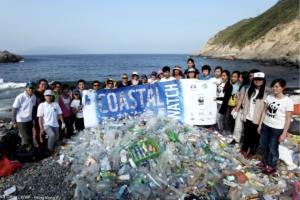
This is where ‘away’ really ends — proof that recycling alone can’t fix a throwaway system.
This thinking underpins the organisation’s work, whether engaging young students, corporate teams, or policymakers.
Making Reuse Easy and Normal
From reusable water bottles to refillable coffee cups and food containers, sustainable behaviour only sticks when it fits seamlessly into daily life.
As Dana points out,
Hong Kong already offers many low-waste options, from wet markets with packaging-free produce to refill stores and reusable container systems. The challenge isn’t a lack of alternatives — it’s habit, convenience, and systems that still favour single-use by default.
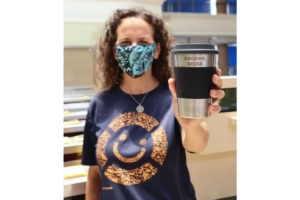
Reuse works when it’s visible, easy, and built into everyday routines.
What Businesses Can Do — Right Now
When working with organisations, the focus is always on removing barriers and making sustainable choices the easy ones.
Simple measures — such as providing filtered water, offering reusable containers at the office, or clearly identifying nearby restaurants that accept bring-your-own containers — can significantly reduce waste when backed by leadership and staff engagement.
As Dana puts it,
The takeaway is clear: sustainability programmes work best when they’re simple, visible, and designed around how people actually behave.
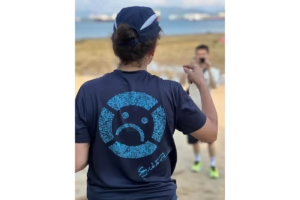
When people see the impact for themselves, behaviour change stops being abstract — and starts becoming normal.
Beyond Individual Action: The Role of Policy
While personal choices matter, lasting impact depends on systemic change.
The goal isn’t just to replace plastic with another disposable material, but to reduce overall waste across the system. That means stronger policy signals, incentives for reusable systems, and a level playing field so that businesses trying to do the right thing aren’t penalised for it.
Without this support, progress remains slow — and uneven.
Schools as Catalysts for Long-Term Change
Education remains one of the most powerful tools for long-term impact.
Three priorities stand out:
- Eliminating single-use food containers in schools
- Installing refillable water systems
- Making recycling visible, consistent, and mandatory.
As Dana explains,
When sustainable behaviours are built into school life, they don’t stop at the school gate. They shape habits at home, influence families, and help normalise better choices for the next generation.
What’s Next for Plastic Free Seas
Looking ahead, Plastic Free Seas is launching a new microplastics workshop, designed to help people physically see what’s washing up on Hong Kong’s beaches — and how closely it connects to everyday consumption.
Seeing the problem firsthand has a powerful effect. When people understand the link between what they use and what ends up in the environment, behaviour begins to shift.
🌱 Get Involved
Change doesn’t happen alone.
👉 Join the Future Green membership to connect with businesses and individuals driving sustainability forward.
👉 To learn more about plastic pollution, education programmes, or how to take action, visit www.plasticfreeseas.org or email at info@plasticfreeseas.org
A cleaner future begins long before the bin — shaped by the choices we make every day, and the systems that support them.
